Showing posts with label Atlanta. Show all posts

Tuesday, May 12, 2015

Adapting to Change

Adaptation is Essential

Stating the Obvious

“The measure of intelligence is the ability to change.”
― Albert Einstein

It may sound obvious, but in healthy systems things change often and frequently. The fact that change exists is less important than how we respond to change. I've worked for several companies that have a poor response to change - it's both treated negatively and the unfortunate requesting the change is treated as a pariah. I've worked for other companies that embrace change as opportunity, treating change as a normal consequence of doing business in an ever changing world.

So what am I writing about here? I'd like to explore how you can help change the attitude of your team regarding change (so it's more positive) and review a few methods to embrace change for a better outcome. I'm using the larger context of "company" in what follows as I believe for this stuff to work it needs to spread across the enterprise. However, what I'm going to write about can apply at the team or macro level too.

First we should establish a list of assumptions:
  1. Businesses that are successful, with very few exceptions, are constantly dealing with change, whether in the market, through competition or ideally due to company innovation.
  2. How a business responds to the changes listed above, can often have a critical impact to company success.
  3. Many times changes are external, a response is required and the speed of that response becomes critical to success.
  4. With software development and new technologies changing the market landscape so quickly, multiply everything above by several factors.

Don't be Oblivious

"I put a dollar in one of those change machines. Nothing changed."
- George Carlin

Before talking about change I think we first need to have a frank discussion about why companies have such a hard time recognizing that they need to change. I've found that there's a very bad trait that becomes inherent in some companies that are very successful - it's the fallacy of success. What happens is that for whatever reason, a company is extremely successful (often through timing and luck and NOT through skill) regardless of questionable practices, to the point that the executive management doesn't take criticism well if at all. This is exhibited when employees recognize inherent flaws or risks in the business, the information is disseminated and consequently ignored. It becomes a "we can do no wrong" attitude that can actually be quite self-fulfilling as long as the market doesn't change, or there are little to no external forces exerted on the company's success. Because of the success management argues that their initial plan is doing well so why change? These are companies that are often blindsided - when change happens they're left in the proverbial creek without a paddle.

It was this mindset that propelled many a start-up during the dot-com era - pretty much unlimited funding, a good idea and huge growth in numbers led many companies to expand quickly with little idea of revenue acquisition. It was all about registrations and not real users. Think about how many of those companies have survived, or better yet, how many of those companies you remember that were hugely successful, only to wither on the vine or become acquisition targets with little benefit to the founders on exit. I have three boxes of swag in my basement - they are full of stuff like frisbees, squeeze toys, pens, mouse pads - you name it and I have it. I acquired this stuff at any number of gigantic conferences (remember Internet World?) and not one of those companies is still around. Someday I hope someone will be interested in that stuff as a research project - or I may just take it to recycling...

Before exploring change factors, we should consider company culture.

Habits

“We first make our habits, then our habits make us.”
― John Dryden

Just as the example above provides some insight about how a company can fail, there are some very good habits that can lead a company from moderate to great success. In most cases, these companies are very good at dealing with change. For it to work, the company's corporate culture has to drive the ideal of change and responsiveness from the top down through example. This needs to be reinforced via company core values, communication and message delivery style; and every level of the company needs to buy into the idea. It also needs to be an automatic response - more good habit than reflex, to proactively look for the opportunity to any change rather than finding reasons not to change. Not that you should jump every time someone says frog, but you have good processes to evaluate change with a managerial support structure to effectively deal with it.

Too often business have complex change control procedures that act as a barrier to change rather than determining if change is first necessary and second worthwhile. Instead its become the norm to only take on change after some upper level management type has "signed off" - more as a CYA technique than as a considered opinion. This often results in someone holding the bag, so to speak, if things "Go South." You'll often see old-school management types keep some unqualified sycophant around so any big problem can be pinned on that unfortunate soul so he/she can be sacrificed if needed.

“It's too late to be studying Hebrew; it's more important to understand even the slang of today.”
― Henry David Thoreau, Walking

Adaptation

“You must be shapeless, formless, like water. When you pour water in a cup, it becomes the cup. When you pour water in a bottle, it becomes the bottle. When you pour water in a teapot, it becomes the teapot. Water can drip and it can crash. Become like water my friend.”
― Bruce Lee

So how to be successful or at least survive change? It's called adaptation - just as some cultures found that survival could be found in assimilation, it's often necessary to consume a change rather than spitting it out. This is most important when confronted by an external pressure, like a change in the market or the presence of a new, disruptive technology. I've always liked that term "Go with the flow" but not in the original context (which as I recall was more of a concession to events), but rather as the idea of adding your voice to the chorus to make beautiful music! Take the positive aspects as opportunity and you can survive devastation - you may get bruised a bit along the way but even those bruises can be turned into learning experiences. If the task looks insurmountable, try breaking it up into smaller, more manageable pieces. Remember, a journey of a 1000 miles begins with one step!
 
A good recent example of adaptation is the current incarnation of used-to-be internet giant AOL. The platform has lost most of its user-base and has become little more than a landing page - however due to brand recognition and fairly-decent news feeds, the portal still gets a worthwhile number of visitors, which equate to eyeballs and advertizing revenue. The company adapted and parlayed that adaptation into a $4B+ acquisition by Verizon - not bad!

Being Nimble

“It is not the strongest or the most intelligent who will survive but those who can best manage change.”
― Charles Darwin

Being nimble is a bit different from being adaptable - in my mind being nimble is defined by your ability to respond to change quickly. If your company has a host of processes you have to go through to make even small changes, then you're probably always going to be behind in execution. Somehow, you have got to spearhead an effort to get things into production environments quicker, remembering the resource triangle (cost, time and quality) and determining what a release can take advantage of to increase speed (hopefully it's cost and not quality, but at times quality can be relaxed - it's all about what you're trying to get out quickly).

To illustrate this idea, how many of you have heard about garage-style start-ups who have pushed what amounts to beta software into the public for the sake of speed. If they are lucky, they'll gain a ton of market share and not lose it due to crappy quality. These start-ups are much more nimble than most large corporate entities - while those are still writing requirements and making marketing plans, the smaller companies are scooping up all the customers, effectively diminishing the pool of fish .

"When you're finished changing, you're finished."
- Ben Franklin

Change Can Be Painful

“We are kept keen on the grindstone of pain and necessity.”
― H.G. Wells, The Time Machine

So what's the plan, man? How, with all this opportunity hanging around there can we best use what's happening to be successful, and make great software? This is fairly old-school, but I recommend as a first step to perform the SWOT exercise. I won't go into too much detail about how to do that - it can be a topic on its own and there's plenty of information available online. You're basically coming up with an analysis of the company's current state and how it stands in its current environment. Please look it up and it will give you some ideas. I do have a recommendation - use the largest pool that you can to come up with your SWOT - that includes executives, middle-management, your core employee pool and anyone else that half-way knows your business, even vendors. Make sure you are clear with everyone that there are no wrong answers and that there will be no repercussions to those who express honest opinions. This needs to be a frank look in the mirror.

I remember the first SWOT I attended. I had never heard of the technique, which was brought to one of my first companies by the COO who was a GE alumni. We got the entire company (about 50 employees) all together in an auditorium, explained what we were about to do and then proceeded to come up with an honest assessment. From that analysis, we had a foundation that we integrated into our company plans, software and sales roadmap, and initiatives and thinking of our leadership - shake well and you have something worthwhile. We ended up being extremely successful and became profitable within 3 years, surviving the dot-bomb. I won't attribute our success to the on-paper results of the SWOT, rather to the interaction that helped to shape our habits, creating a consistent message across all levels of the business, and aligning a program that considered all aspects: strengths, weaknesses, opportunities and threats. We were also very adaptable and nimble (it's also how I got my first taste of agile software processes and frameworks). Not to say it was all gravy - there were certainly mistakes made, however we were fairly good at learning from those mistakes, improving our business and processes; and having some fun along the way. Thanks for reading.

-- John

"Adaptability is not imitation. It means power of resistance and assimilation."
- Mahatma Gandhi

(also posted to LinkedIn)

Friday, March 27, 2015

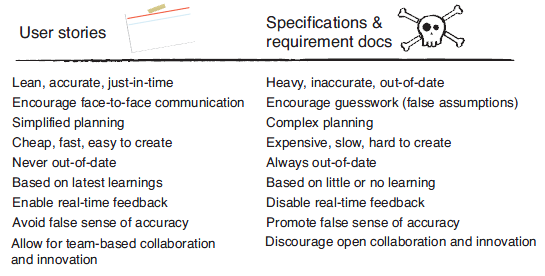
The Fallacy of Converting Requirements into User Stories

Borrowed from www.itworld.com

The Fallacy of Converting Requirements into User Stories

I don't know how many of my Product Management peers (or those others of my friends who work with scrum teams) have experienced a transmogrification/migration of a waterfall/RUP team to agile, but one common element seems to be the initial attempt of moving existing requirements into User Story format. Invariably a list of requirements is simply moved into an agile project with little or no editing - and it's amazing how many shops think that this completes the transfer. I also had a very interesting experience while working with a fledgling team in a new jira implementation which I'd like to relate.

The story of Excess

I had come into a new team that was trying to adopt to a scrum framework. While the product manager had some agile experience, it turned out to be rather sub-optimal to what would be considered a good, best-practices based agile approach (that PdM wasn't me, by the way). The requirements that he had inherited when hired defined a fairly large online application with multiple components include most of those you usually find: user creation, onboarding and maintenance; order lifecycle management; business process management; reporting and analytics, etc. Those requirements had been collected via existing business analysts and put into a traditional requirements document by an outsourced company via a product management requirements application (I don't recall which one, but basically each topic, section, sub-section, use casee, etc cascaded in an orderly fashion using numbering: 1.1.1.1 - you've probably encountered this before).

In a rush to get these into user story format, this PdM had all the data exported from this tool into a flat file (spreadsheet) and then imported into the adopted agile management software (in this case, jira). Since very little manipulation of the data was done before the import, this resulted in line items defining topic headers turning into User Stories with little to no content. I'm talking thousands of user stories with hundreds of summaries and no descriptions. Trying to sort this out, this PdM then had the company license a plug-in called "structure" (or something similar) that would then straighten out all the stories into some type of readable hierarchy. The whole process ended up taking several months. At some point I was asked my opinion about the whole thing (or perhaps I saw the result in conversation and just opened my big mouth, I don't recall which) I asked "Why don't you just start with the first component and decompose it into useful stories, describing an MVP to get the project going?" - actually my question wasn't that elegantly phrased, but I want to get this story going). The argument against doing this method was that so much time had already been spent with the current export/import mess. Of course this went on for several months - and the development team wasn't very happy with these stories or the way things were being prioritized. I eventually convinced the PdM to try my way and junked all those existing stories into an unused project.

So what went wrong, exactly? 

  1. The product manager was pushed into doing something with the existing requirements so the project could get moving. For the sake of speed and being able to claim "There's 2000 user stories in the backlog" the export/import wasn't thought out very well. At minimum, when you use this type of approach, you should consider how the data is formatted (perhaps by doing a few sample records and seeing how things go?) and making adjustments on either side of the ETL or via a manual clean-up of the data file. To me pulling in requirements like this is probably a good way to have starting, stubbed-in topics but lack just about everything else necessary for a good agile backlog of user stories.
  2. Trying to fix this kind of mess causes it's own time-suck - months were used in trying to first interpret the lack of canonical structure, then by selecting software that made an agile tool more like a traditional waterfall requirements tool, the stories themselves gained very little (it ended up just making things easier to read for the PdM, otherwise there was little to gain). Months ended up being used to fit all the user stories into the hierarchy that the structured tool provided. That time would have been better spent establishing a method of establishing MVP for each project phase and working with the scrum team to determine the best approach (this last bit was made difficult as the team was still being hired - the product manager did the best he could with what he had).
  3. The third factor had more to do with time pressure and the need to derive some value from the work that had already been done. I'll focus on that a bit in the next section as a potential process solution.

So what is a better way?

It's always easier to look back and figure out what went wrong and fortunately we all survive to learn from mistakes. I'm going to cheat a bit and limit the solution to converting existing documentation rather than go all high-and-mighty about how the requirements were derived. We who have been practicing agile and scrum for a long time realize that there are many approaches to translating requirements into user stories and much depends on the expectations of the team, company and established principles. Some methods are good, some not so good, and sometimes we have little choice in the matter. For me, I like to have conversations with the people using the software (the business, consumer or end-user) and work backwards towards the solution, focusing on the desired outcome rather than on the tactical implementation - that latter part I think ideally should be determined by the entire team. Unfortunately in shops that are adopting agile, there's a lot of baggage that we all have to contend with and sometimes it's just not worth the effort to overhaul the entire process - better to make small improvements that lead to big changes over time. So how would I approach a similar scenario as my story above?
  1. First I would carefully read and try to understand the existing documentation. Presumably it's been done well and is worth circulating to engineering and executive leadership - after all someone had to go to the effort of putting it together. I would also do some spot checking against any critical requirements to ensure that enough due diligence was done while putting the document together, by validating those assumptions with end-users.
  2. Next, I would circulate the overall effort with engineering leadership to help define the near and future goals of the software. This is to establish some design principles and at least create a contextual framework focused on data, objects, interfaces and general principles, especially around the moving, calling and updating of data. Your engineers usually already have some coding standards - now is the time to get buy-in from the group so there's a bit of consistency in implementation against the overall project scope. The outcome of this should be some good architectural diagrams of the various components necessary to get to the endgame. This can then suggest the best method of execution and the start of user story creation.
  3. Using the existing document, I would then see if the topic headers fit the suggested method of execution - the higher-level topics become epics that are further decomposed into user stories. Sometimes the sub-topics fit well, and other times they don't so they may not be very helpful (generally they are).
  4. The guts of the requirements are then used to write the user stories, which should be abstracted. Typical requirements are too specific - they tell the user what to do. Instead the approach should be one that tells the developer what the end-user want's to accomplish as a foundation of a collaborative user story. The baseline requirements could still be useful in determining the number of field values that may be required due to some external dependencies, etc but in general the perspective of the story itself should focus on who has a need rather than what needs to be done.
  5. At this point the high-level topics for the near-term should be fairly well defined, with less definition for the other parts of the project. As each component part is elevated in priority in the backlog, each story is evaluated by the entire scrum team with a focus on context and what the feature is trying to solve. The story is edited to make sure that we're all on the same page and there's a clearly defined acceptance criteria so we all know whether the story has been successfully completed.
So easy, right? Like I wrote earlier, its much easier to determine what went wrong and suggest something better in retrospect, rather than while things are happening. The fallacy that I refer to in the title is the assumption that a Requirement from traditional waterfall or RUP development means the same thing as a User Story in Agile/scrum. They simply don't, and because the intent of each is different, relabeling doesn't work.
Borrowed from http://agile4freshmen.blogspot.com/
I remember my first experience with agile - we did exactly the wrong thing. I basically took a traditional requirements document and did a search-and-replace of "Requirement" to "User Story" - see, since we were also doing scrums, we're doing agile! It actually took quite a bit of time and experience to realize that what we were doing was adopting some of the ceremonies and artifacts without really understanding how things fit together. The problem is that often even adopting small parts of the agile framework can produce a positive result where a development team sees improvement. It's my opinion that there are as many teams that think they have successfully adopted agile as there are those where agile adoption has failed, each for the same lack of understanding.
-- John
(also published on LinkedIn)

Saturday, December 6, 2014

Revolution vs Evolution


I've recently been in a few discussions with colleagues about software innovation and how it relates to product management so I thought I would share a few thoughts. We always talk about opportunity, and frankly, we usually use it in a context to defend or soften a product decision to an end user (aka client). In this way we use words like "opportunity" to define a problem that needs fixing - since many of us bill for the work, the term "opportunity" equates to making more money, at least to a consulting company; and the use of the term "opportunity" is much more palatable than "problem." Instead we should identify problems as problems and spend our time working through solutions and really, isn't "solution" a better term than "opportunity"? In any case, I digress, as the topic I want to explore is one of innovation.


What got me thinking about this is an encounter I had earlier this year with a process improvement group. This is the scenario - I'm working within a project to rewrite existing software using new technology and better design principles. Most of the requirements were derived from interviews with the management teams using the existing software (they in turn presumably worked with their teams to come up with innovations and improvements). Fairly straight-forward, right? We then took those requirements and began exploring implementation converting the requirements into epics and user stories, to get the conversation going with our team, derive executable bits and present them back to the business users as we move from bits, to MVP, to production release and consumption. We take a very agile approach to software development so the first hurdle was to get our business users to adapt to this practice - not an easy task. Our BUs tend to throw everything into the requirements and their initial expectation was that everything listed would get done - which made it very difficult to get things through UAT, even when we constantly explained that it was a planned cycle of development moving from simple to complex. In their minds, "working software" meant that everything they wanted on the requirements was done, to be able to define the software as working. Once again I digress, but this time to help provide some context.

In actuality, there's an inherent problem with this requirements gathering method. First, the innovations asked for by the business user usually relate to the existing software platform and amount for the most part to tweaks or small process improvements. Second, when those requirements come through the management filter they tend to be broad-stroke in some regards, and myopic in others (depending on what the manager perceives as important). Third, the methods that the business user is defining in requirements are usually the same as the original software without thinking about how the entire application could be improved by changing the underlying software method - what I mean by that, is when you have staff trained to use software and they are used to that software, it's hard for them to think about an entirely new methodology that's outside of that experience and context. So to continue my story, some of the things we introduced in the rewrite had to do with using an off-the-shelf BPM engine. Our thinking was "why reinvent the wheel when there are already so many companies out there who have figured it out?" So this became the first point of contention - even through a BPM package may satisfy the baseline requirements, there are usually some fairly rigid rules within a fixed methodology that are required by the software itself. It's a tradeoff - you get better accuracy and many of the bells-and-whistles you're looking for, but to take advantage of them you need to conform to the methodology designed within the software. Once implemented, the next challenge was to get our business users to understand that the methods have changed - the outcomes are the same, but by using something more standardized, it will be easier and better to use the same software to do similar tasks. This change is rather disruptive, produces a lot of user angst and confuses people, who are still used to using the original, legacy software.

So around the time we first got our users used to the changes with the introduction of the BPM technology, we were introduced to a new process improvement group. Seeing this as an "opportunity" - the group was brought in to look at the existing methods and suggest improvements that could be incorporated into the newly designed software. This included analysts actually sitting down with the business users and observing how they use the software. We welcomed the additional resources and hoped that a few "magic bullets" would be identified to really make our newly rewritten software fantastic, hopefully saving money and time by identifying process improvements through the application of technology. So now, we're getting to the crux of my article.

The report that was delivered was interesting, not in all the suggested changes and aggregate analysis defending changes to the overall workflow, but in that it copied almost requirement-by-requirement what we had already defined and planned in the rewrite. It basically validated what we already knew and made the same improvement suggestions that we had already planned. What we received was evolution, rather than the hoped for revolution. And please don't think that I'm diminishing the importance of what the process improvement group did - it's nice to have validation in what we are doing and have planned and there's certainly value in that. I think that as a group we had much greater hopes and that our expectations were unrealistic. I also think that in our world of software development we spend a lot of time trying to improve things rather than searching for new solutions - that outside-of-the-box solution that's so new it can redefine what we are doing and how we are doing it. Not to say there's no value in evolution. One of the easiest things to defend are improvements that cut the bottom line - even small process improvements can do this and the accumulated savings can be quite significant.

So what is better? In my opinion, revolution is thinking about a problem and coming up with a solution that is so novel it doesn't fit within the original problem statement. The downside is that it can be very risky. And no, the ideas don't often happen overnight. Evolution on the other hand, involves small, incremental changes and has less risk, but when that's what you rely upon, you could get trumped by a new market contender with revolutionary ideas. I really think we should use both methods but in general try to think in revolutionary terms - more of a mindset than a strict method. We should embrace the good ideas backed by real data, and defer on ideas that offer little to the bottom line that have no data to support them.

How I long for a time when I receive information that is filtered for relevancy (important to me and customized for my needs), from several sources, all in one place using a single sortable and filterable delivery mechanism. There's been a metamorphosis of thinking when it comes to communication that started with emails, went to the use of distribution lists, forums, communities, wikis and now messaging aggregation with software like Slack. This last example is something transformative that's been happening for several years and is only now beginning to get some attention outside of software developers. You would think that this is an example of evolution, but when it moves outside of the development word it becomes revolution.

Saturday, November 15, 2014

Good Product Management is Based on Good Data

I harp on this all the time and I'm sure my colleagues are tired of me saying it - but I'm of the firm opinion that we should DO NOTHING in regards to product management or product development, without the data to support our decisions. The foundation of any change is underpinned by data to support that change - whimsical changes or even changes supported by some perceived need, mean very little without supported analytics. Foregoing the due diligence, even for small changes can not only be detrimental to the application but can also ultimately impact your company's bottom-line. You do not want to be in the position of defending your actions, even if they seem innocuous, against a product backlog that has real calculated ROI.

Even Dev Prospecting (the idea that sometimes we need to push a change that could garner new business or customers with some nebulous "maybe" result through innovation) should have a minimal data construct projecting what may come from doing so. For this I look at data models in parallel or similar affinity vertical markets.

If you aren't paying attention to the data, making some effort to understand the trends, and have the ability to filter the noise and make some decent projections based on what you see, you're doing more harm than good. So as a Product Manager, what can you do to get this data?


Research: Public Searches. The first avenue for any good product manager is to start doing some searches online using probably keywords. I think most product managers already have some ability at finding public information - it's a skill one develops over the years and is a good starting point for just about any knowledge gathering. Google is your friend, but this is only a starting point. I'd suggest you start brainstorming and as you broaden your searches, additional keywords will suggest themselves in the results you find. Make sure you note what you find but stay relatively focused using the additional words as possibilities as they can get you really distracted (ask me how I know?).

Research: Examine Your Internal Data. The second tool in every product managers tool-kit is internal data. Most of us have applications that have been running for several years and the data is sitting there for the grabbing. Look at the data points you have and see if there's information there that can be used for modeling or to suggest avenues that support your case. Just be careful, especially if you're forecasting to take this data with a grain-of-salt. Using existing data works great to support cost savings; it's much more dangerous to use it to support revenue opportunities.


Research: Use Your Existing Customer Pool. It's always blown-my-mind when I've come to a company and realized that there is almost no interaction with the existing customers, beyond simple support and account management. If you have enough data to identify problem areas in your application via support calls and emails, what's more useful than to reach out to your customers and start a conversation. Begin with what they like, move to what they don't like, then start suggesting things you'd like to do. The information you receive can be quite compelling and leading you to paths making good application decisions.

Research: Use Your Existing Sales and Support Pool. As above, we often receive feedback for what's wrong or bad with what we are doing from an application level. What's harder is to get a sense of what really needs to be changed or fixed. Use data as the foundation, then interviews with your coworkers to gauge what will have the most impact - you'll often be surprised at what you find out and once again, these are leads that can direct you towards real innovation. I love getting sales figures and using the information to defend a case for doing something, or even better, against doing something being driven by someone with influence but no clear understanding of what's needed.

Big Data and DataScience. The last and this is something that I'm a big fan of - hopefully your company has embraced DataScience and hired a good python developer to parse through your tables. It's amazing what can be discovered by trending data and looking for graph-outliers or anti-trends. As product managers, we need to better understand how this last tool can be used effectively, to support our case when making product decisions.
I think most product managers understand all of this, if at a very subconscious level. At minimum, keep your mind open and don't simply disqualify ideas being promoted by your coworkers - I know that we're all busy and that this is easy to do, but your do yourself an injustice and really exhibit a lack of respect for those you depend upon the most.

"I get it...I get it"...

-- John

Tuesday, October 7, 2014

Get Active!


Having doing Product Management for many years I found myself recently in a bit of a slump - at some point I reached a threshold where what I was doing just wasn't very satisfying. This was due to several factors:
  1. Post-Release Blues - the "1.0" of my most recent responsibility had gone to market which is really exciting. All the months of creative energy expelled in a giant burst, which ultimately ended up being anti-climactic - to achieve an MVP the product was lacking in several key areas to really make it functional. These were the result of a lack of understanding regarding the real needs of the user - we had made some assumptions, and as usual when you make decisions based on guesses rather than real data, those assumptions led to a less-than-usable product.
  2. Post-Release Follow-up - So the next several months were spent bringing the product up to what is/was the actual MVP. This included bugs but mostly it was lack of processing functionality (not as in calculative capacity, but rather in business process management function). We've finally gotten the product to a point where it was relatively safe to release to the public, and more importantly to our internal business users.
  3. New Priorities - of course things changed during the overall process to release to 1.0 and these new changes (support for an entirely new conceptual product-line) also added complexity that mired our teams for several months (and it didn't help that the requirements changed several times before we got this right). Luckily the agile process allowed us to be nimble and adjust our product roadmap to bring these new features to the forefront. It did cause a bit of a stir company-wide as our roadmap and commitments changed. Tough to do this in a relatively heavy top-down managed company.
  4. Note Celebrating Small Successes - nothing like feeling like your behind to keep you from enjoying things that go right. We all need to keep things in perspective and it's often difficult to see the trees when you're in the middle of the Sequoia National Forest.
So in total, my overall morale had been low. So what to do about it? In my case I became more active in activities set to expand the mind - and no I'm not talking about mind-expanding drugs. I started to go to local industry meets (it's helpful if your company is part of the local tech scene - in Atlanta there's the Technology Association of Georgia (TAG) which is helpful as there are always meetings by various associations going on - I joined the Product Management association within TAG). But don't limit yourself there. I also joined the local ProductCamp and started to go to the yearly unconference and at some point will participate in presentation. But getting involved in those two groups was like having an appetizer during a nice meal - you want more! Besides the local, more formalized groups, look at MeetUp and what it has to offer. What to do?

My suggestion is to expand outside of your normal circles - start on the technology side and move outward - see where it goes. I have a firm belief that from a product management perspective, anything that we do to further a product should be first supported by good data. If you don't have data how do you know that what you're doing meets what the market wants, or through extrapolation, what the market could want (emerging or untapped markets)? Everything that we do as technologists should be supported by data. So what's more natural than to get involved in the local data groups? I joined both the Microsoft BI group and the Data Scientist ATL group - the former is a bit more on the technical application side while the latter is more about theory and the procedure/process of collection and filtering. Both are interesting in different ways and a byproduct is that you will meet people that may not be in your normal circles. I really enjoy both groups and they have expanded my horizons. The latter group is also very social - I think this is an important aspect of what we do as technologists that becomes lost in all the work we become saturated within - meeting people at a more casual level lets the mind explore new possibilities.

An example - during the last Data Science ATL meetup I met several new people - one was a consultant who really liked to connect people of similar mindsets to each other to promote technology and innovation; the second was a php UI developer (Not a group I normally associate with); the third was a data scientist. All three were co-mingling, having snacks and a couple of beers with discussions roving all over the place: work, technology, possibility, networking - you get the idea. Somehow I got into a discussion regarding SpaceX and what Elon Musk is doing in the private sector and this got things rolling into what new innovations along those lines were being explored here in Atlanta. The result was unobstructed idea flow, laughter and an expansion of awareness. It's also how the beginnings of an idea happen - often through casual conversation - you just need to find the right people to involve in those conversations.

Taking some of the thinking regarding these groups and what I found there, I started my own MeetUp group - this one around Socal Business application (meaning the application of social networking tools to the enterprise) - something that interests me. I've had one meetup so far with a little over half attending. It's a start and it gets things going - if nothing else it gets my own mind moving. Details about Atlanta Social Business Product Management. If you look at my last couple of posts you'll see reference to the MeetUp and what this topic is all about.

So where does this take you? I don't think it matters - what matters is getting your mind into new situations and possibilities so you aren't so buried in the day-to-day grind of achieving sprint goals. Step away from your desk occasionally and have a conversation with those in your office you don't normally interact with. Join your office leadership committee or volunteer to help plan office events. Do things to break up your normal activities so the job doesn't wear on you and you'll be glad you did - your employer will be too (as long as you don't do anything to get arrested!).

-- John

Monday, August 11, 2014

The Argument for Social Business

There's currently quite a bit of buzz around the term Social Business - especially around HCM (Human Capital Management) so I thought I would address the term. I think what makes it a bit confusing is that the term is already used as defined by Muhammad Yunis in 2009 in his books "Creating a world without poverty - Social Business and the future of capitalism" and "Building Social Business -  The new kind of capitalism that serves humanity's most pressing needs." The books in general are about changing business prime-directives from maximizing profits to financial self-sustainment and re-investment. This is much different from the term Social Business used to describe a socialization trend happening in businesses that refers to the use of social tools in everyday business practices.

A better term might be "Collaborative Business" and in general refers to the use of some of those abstract constructs used in social networks but applied at the business level. Most of these constructs involve the "group think" concepts of shared posts, transparent threading of messages/emails/posts, the aggregation of interactivity across multiple tools and the community aspect of collaboration as embraced by businesses, at minimum internally and ultimately with external clients and experts. Ideally Social Business incorporates the various communities involved with the business and introduces a higher degree of interaction between the communities. The stress is on engagement and the result can be measurable depending on how things are defined (aligning the goals of the business with the efforts involved in sharing information). HCM has begun adopting some of these constructs, especially for internal communication but I believe to be effective these tools should be implemented beyond the enterprise - however it's still a good first step at implementation.

IBM has done a rather remarkable job introducing the concept into it's core communication - much of this came about through a corporate initiative to allow its employees to blog articles to help disseminate information which then lead to their hosting both internal and external blogs - this was followed up by the extension of the old Lotus Notes into the current Domino product. I recently attended a TAG Social Society event (and if you haven't joined TAG - the Technology Association of Georgia, then this single group may make it worth while) that had the topic What Will My Email Look Like “Tomorrow”? (it was actually a combined event of separate TAG groups but the presentations were mostly around Social Business). Louis Richardson from IBM was the keynote - he started out with the the quote "Email is where messages end up to die" and spoke about the relative waste of using email to communicate, especially between a group trying to get consensus on a decision - his example had 6 people in it who all had to copy the entire group every time a comment was made. By the time several people commented (and some copied as yet other interested parties) there were quite a few emails in total (I believe he said the average is 150 emails to make one decision). He then referenced the way Domino addresses the problem - I won't go into detail but if you're really interested you may want to look up the feature description.

I'm using the IBM and the TAG Social Society reference above to illustrate my point - there are many thinking about the future of communication and collaboration and how it will be addressed by business, especially enterprise business. Why all the interest? If you look at the demographics, particularly of the Millennials and post Millennials that are making their way into business, you'll understand that this latest generation interacts differently with information than most of the "gray hairs" currently controlling business. This new group is used to multitasking using a variety of electronic devices, combining messaging, video, text-in-email, social media - you name it and they use it, often all at once. It's been observed that the group in general has become "wired" differently in the way they think - with information coming into the funnel (so to speak) in multiple work streams. The biggest change is the way information is collated by multiple participants into threads (the advantage is that information is shared to a larger group without multiple posts like in the email example provided by L. Richardson above).

Think about being a Millennial and being used to this work stream way of thinking, then hitting the plodding methods traditionally (well, at least the last 20 years) used by business where email is king - I can imagine the frustration and lack of enablement - and this may explain why companies who have adopted a more collaborative way of communicating using social tools have become so successful - Google is a good example. It might also indicate why so much of the talent pool is moving towards these "hot" companies (yeah you get free lunches and you always hear about the company culture - but is that enough?). My theory is that if we don't provide a communicative atmosphere of collaborative tools we aren't just missing the boat, we're basically given a paddle and told to make the best of it.

That that end, I think that the beginnings of the solution has already been adopted by technology teams (they tend to be the first to adopt good ideas) in most software development shops through the use of collaboration tools like Campfire and github. Many of the tools and ceremonies have also been adopted by the Agile and scrum shops to improve team communication - and it works! so I've pitched the idea to those I know who facilitate the agile/scrum model. To further examine how Social Business might be implemented, I've created a new MeetUp group called Atlanta Social Business Product Management (yeah it's obnoxious but I couldn't think of anything that had more zing). Please join if you're interested.

Monday, July 28, 2014

The Three Laws of Software Development - Conway's Law

During a recent class, Peter Saddington referenced three laws which collectively are knows as the Three Laws of Software Development:
  1. Humphrey's Law
  2. Ziv's Law
  3. Conway's Law
I wrote about Humphrey's and Ziv's Laws in my previous posts. Conway's Law is perhaps the one that is most well known of the three.
Looking up "Conway's Law" you'll find it in Jeff Sutherland's book "Exploring Scrum: The Fundamentals." Conway's Law is an adage named after Melvin Conway who first mentioned the idea in 1968. It states "Organizations which design systems...are constrained to produce designs which are copies of the communication structures of these organizations" or it's also written as "If you have four groups working on a compiler, you'll get a 4-pass compiler" (sic). That second version is a bit dated by today's standards. I believe Peter stated it a bit more colloquially as "Software always mirrors the group that built and designed it - if the company is dysfunctional due to poor communication then the software will have the same dysfunction" or simply "everyone needs to communicate better."
This law is as proverbial as the previous two and like them, is more of a valid sociological observation. I found this diagram by Manu Cornet on Bonkers World that I thought was pretty funny and actually a fair representation of Conway's Law...


Manu's diagram isn't specific to Conway but you can infer what you like. The Microsoft and Oracle diagrams are especially telling. Peter tied this law into the need for excellent communication and collaboration as a necessity in producing great software. I've personally seen this law represented myself in the many start-up companies that I've had the honor of working with and the opposite end of the spectrum, large corporate software endeavors (at some point I'll relate a project that had over 100 sign-offs).
Early stage Start-ups are typically small and have a tiny organizational chart - the software produced is usually fairly simple structurally and the communication is more one-to-one due to the tight org structure. This ability to be nimble due to size produces many advantages, especially the ability to go to market quickly. Larger organizations begin struggling to produce software with any speed - there are so many check-points and stakeholders involved in the production that there are often small changes that impact both the software in complexity and the company's ability to market quickly. Large corporate entities are often bound to many revisions, checks-and-balances, approvals - you get the idea. Not only does the software fill with complexity but releases become a nightmare.
Tying back to the class, the emphasis is to make small incremental changes and expose those changes for approval back to the stakeholders early and often so the team can adjust and do a better job meeting expectations. Not only do you produce better and more efficient software, but the release becomes less problematic - there are fewer surprises. I don't know how many times I've worked on a project where the smaller changes truly delight the customer while the larger changes produce confusion and revolt - this is usually ascribed to poor training but even taken that as a viable excuse, doesn't it amount to a lack of communication?

Monday, July 21, 2014

The Three Laws of Software Development - Ziv's Law

(previously published on LinkedIn)
During a recent class, Peter Saddington referenced three laws which collectively are knows as the Three Laws of Software Development:
  1. Humphrey's Law
  2. Ziv's Law
  3. Conway's Law
I wrote about Humphrey's Law in my previous post.


Looking up "Ziv's Law" you'll find it in Jeff Sutherland's book "Exploring Scrum: The Fundamentals." Ziv's Law states that software development is unpredictable and that the documented artifacts such as specifications and requirements will never be fully understood. First we need to all agree that new product design is the fundamental nature of software development - and that basically whenever we're creating something new, no matter how close it is to something we've done before, it's impossible to be confident of all the constraints and needs of this new development. Sure we can do some affinity comparisons to something we've done previously, but there's always some variability (if there wasn't then why didn't we just use what was built the first time?), and it's virtually impossible to predict the outcome with much accuracy due to this variability. And further, the more the new development diverges from the previous, the more unlikely the accurate prediction of the outcome.


This law, much like Humphrey's Law, is about uncertainty. It's all about the precision of functional and non-functional requirements in regards to software development projects - no matter how well they are understood and written during the time of scoping and initial refinement, things tend to change while the actual development is going on (whether the business need changes or there are changes inherent to the development process itself that impact the complexity). This law is important because it's fundamental to understanding how the agile process, and scrum in particular, addresses this particular issue.


With scrum, because the intervals are fixed and the stages of development divided into bite-sized chunks that can fit into the interval, there's more room to make adjustments in the subsequent intervals (sprints) to allow for what is discovered. This also brings into play the experiences of those working on the user story (i.e. your technical team) so you're already getting additional input into the outcome. All this leads to a much more satisfying final product, both for those involved in the process and for those who are supporting or needing the results of those efforts - and after all, that's what we are trying to do, delight the customer (general term for whom we're doing the effort).


So why is this law important? It has to do with failure and what we do as a result of failure. If we accept that what we are building in any one sprint isn't perfect, then we'll understand that the feedback we receive from the customer for what's been done can be incorporated into the next sprint, allowing us to make adjustments to a final, satisfying outcome. Small failures are OK and should be expected - it's the ultimate result adjusting to those small failures that will make us successful.


-- John

The Three Laws of Software Development - Humphrey's Law

(previously published on LinkedIn)
During a recent class, Peter Saddington referenced three laws which collectively are knows as the Three Laws of Software Development:
  1. Humphrey's Law
  2. Ziv's Law
  3. Conway's Law
I had never heard of these observations referenced as "laws" and wanted to explore them further with my own research. Apparently Conway's Law is used in some scholastic software development classes but the other two are a bit obscure to me. We'll start with Humphrey's Law.


Looking up "Humphrey's Law" you first encounter a Wikipedia entry regarding something called "The Centipede's Dilemma" - which is something psychologists call the centipede effect or the centipede syndrome. The reference has to do with what happens when a normal action is interrupted by the person's own awareness of the action. An example might be a baseball player who normally uses his training, muscle memory and a bit of instinct to swing and hit a home run, but because he's consciously aware of what he's doing, he basically over-thinks the action, causing him to strike. The effect is also called hyper-reaction or Humphrey's Law, named for English psychologist George Humphrey, who wrote about the effect in 1923 using a poem by Katherine Craster, usually titled "The Centipede's Dilemma." - yeah I know I'm getting fairly esoteric in this but I think it's good to understand where this stuff comes from.


The Centipede's Dilemma
A centipede was happy – quite!
Until a toad in fun
Said, "Pray, which leg moves after which?"
This raised her doubts to such a pitch,
She fell exhausted in the ditch
Not knowing how to run.


While the poem is interesting it does illustrate the main point, which is "Thus, the eponymous "Humphrey's law" states that once performance of a task has become automatized, conscious thought about the task, while performing it, impairs performance. Whereas habit diminishes and then eliminates the attention required for routine tasks, this automaticity is disrupted by attention to a normally unconscious competence." - rather obscure, right? So the question remains, how does this fit into the Humphrey's Law as referenced by Jeff Sutherland, co-creator of Scrum and where the Three Laws of Software Development idea was presented?


Jeff Sutherland's version of Humphrey's Law states that "users don't know what they want until they see working software" or to paraphrase Peter Saddington, "People don't know what thy want until they see what they don't want." This seems to be the opposite of what "Humphrey's Law" as referenced by psychologists means, although they do share some common threads:
  1. Both ideas are about human response to exterior stimuli
  2. Both ideas are observations which seem true.
  3. Both contain an element of subconscious objectivity
  4. Both share the same name
I had original concluded that they are the same law, only cross-referenced from the perspective of the observer for the Software Development reference, and from the subject (actor(s) aka centipede) in the psychologists' version. Of course this was purely conjecture - and someone commented on my thread on LinkedIn to say that it's actually a different Humphrey - a software developer.


So what about application? These types of laws represent an observable problem, so using the adage that one must first recognize the problem before it can be addressed, the next step is to identify how Humphrey's Law is impacting the development of good software and using various methods to resolve the issue. Peter did a great job illustrating the problem using a "I want a car" technique that I hope to demonstrate to the product guys and my teams at Altisource Labs. I'm working through this now in the form of an interactive class and demonstration which I'll share with you in a subsequent post. In the meanwhile, I'll continue exploring the other two Laws in my next posts.


-- John

Building Personas

(also published on LinkedIn)
From my last post you may have garnered my desire to begin using some of the Pragmatic Marketing training and incorporating the best ideas into my current projects. Specifically, I began creating personas to use within the user stories and to support each development effort by providing additional context for the team members. When I broached the idea with the development team I initially was met with silence. On further discussion with some of the team members I received a rather interesting response "Well, yeah those are fine for UI but they really aren't useful to a developer." I met this with a bit of dismay - I really thought they would buy into the idea of providing additional context, as the current development groups (we went from a highly efficient team to several inexperienced teams) need all the context they can get. The counter-argument I received had to do with security settings and how typical UI-type personas did not provide enough information to determine access controls. It's interesting how some of those same members who desire efficient agile teams argue against using tools to make it so.


To reinforce the idea, a recent CSPO class emphasized the same thing - provide personas that can be used to help get the team into the mind of the user. At this point I could use some hard data to support the idea (mostly to get buy-in from the team) so anyone out there reading, if you have some fact-based analysis I that I can use it would be helpful in supporting my ideas. In the meanwhile, I'm continuing to build my personas to support epics/stories going forward, hopefully this will nudge the team into being more accepting. As to the question of security settings and access controls, it seems that if the personal has a well defined description and these are of importance, the information can be added into the personal description, no?


In any case, I'm currently defining personas for about a dozen different user-interacting roles into the current application. More updates to follow.


-- John

Saturday, July 19, 2014

Pragmatic Marketing and Scrum

(a slightly different post published on LinkedIn)
For the past 13 or so years I've been working in a variety of software development shops practicing Agile, and generally some modification of scrum. My focus has always been to take the ideal scrum implementation and continue to make it better - I can say that I've only found a very few shops that practice the "ideal" version of scrum as conceived by the founders of that term. At some point I'll get into that a bit more but the purpose of this article and a few to follow are to take what I've learned most recently from the Pragmatic Marketing training, and apply bits-and-pieces to my current job situation.

First a bit about Pragmatic Marketing.
I believe I first found Pragmatic Marketing in the early 2000's - at the time I was a Director of Technology (my role was more of a Product Manager one, I just didn't realize it yet) for a small start-up that had begun making some headway - in fact we were just turning a profit and had begun to expand the various departments of the company, including Product Management. We hired a very good upper management PdM person who, when presenting his ideas, etc. suggested that we might want to take a look at the materials provided by Pragmatic Marketing (I'll use PM going forward) to guide our expansion plans - at the time you could sign-up for a free PM print magazine that was published, I think either quarterly or bi-monthly and by signing up you had access to the other materials and past issues as PDFs (I may still have those stored in my files somewhere). After reviewing most of what was there we started to employ many of the ideas and also the terms associated with the course - it basically gave us a basis of terminology that was previously missing. Of course, being a start-up it was hard to justify taking the paid-course, but I had always been curios about it.

Next, about the current implementation of scum in my current position.
I function as a Product Manager for two different development groups. The first is a legacy platform that is primarily in maintenance mode, so it's a rather small team practicing kanban and mostly doing user stories relating to reporting needs to compliance and regulatory changes. At some point this team will be absorbed into other efforts, but at present there's enough work to keep them busy. The legacy platform has been running for over 10 years and frankly many of the efficiencies from 10 years ago have been exceeded by company demand which leads to the second group. Group two is a complete redesign using a different technology stack and a common services platform. The second group has gone from one team to five, then shrunk back to a single, consolidated team and now is expanding again into three teams. I share the product owner role with another product manager and we're lead by a Director who acts more as a principal product owner (his focus is more on the strategic direction and he has responsibilities tied to the P&L). From my scale, these newly defined teams are about 70% where I think it should be from a classic scrum perspective (it continues to get better but there's still a bunch of work to do). The group two team started with scrum and was relatively successful up to the initial release of the new product. Recently the expansion of the team into two groups (and building to three) has lead to inefficiencies and our velocity is shot.

A few weeks ago I attended three Pragmatic Marketing courses: Foundation, Focus and Build.
The main thing that I took away from the classes was that I already knew much of the information (you would expect that after 13 or so years doing product, right?) - the classes actually provided a framework of using what I already knew that was a bit more organized. It also provided some insights and approaches that I hadn't tried. Now we get into what I've learned and what I intend to implement to improve our teams.

There was an interesting graph as part of the Build class that I want to share, that has relevancy to what I've so far described. This has to do with context, and how it impacts the effectiveness of teams.

Basically, the first tenant is that the more context a team has the more efficient they become in executing what the market needs.
The better the context, the less that needs to be expressed as any type of requirements for a team - that's not to say that there doesn't have to be documentation, but due to the past shared experiences of the core team, the high trust levels between all participants, and the familiar processes, the teams reacted well, quickly and accurately to requests coming from the market. This is really the ideal state of a good scrum team, where from a PdM perspective, just enough detail is included in a user story. This is well illustrated by the previous velocity of the teams while executing the initial release of the product.

The second tenant is that the less context the team has, the more content and requirements product needs to produce for the team.
The analogy is to take some software feature to a contract shop - because they have very little context, they need much more information in order to be successful - this ends up being lots of artifacts, requirements and specifications. You can see that by expanding our previous team with many new, novice team members we should have adjusted as product managers by providing much more context, to help them ramp up and be successful. By having the unlikely expectations that these newly formed teams would magically become as quick and efficient as the original teams (the idea is to spread the experienced members across the new teams as leadership, so they can impart the technical information needed to get the teams up to speed) within a couple of sprints, we didn't consider that the amount of context provided to the team by product needed to correspondingly increase. So one simple graph and about 5 minutes of discussion in my PM class provided a world of context for me, in first identifying the problem and then taking some steps to improve the situation.

So what to do?
There were several recommendations that I drew from the classwork - remember that the main thing I'm trying to fix is a problem of context - how to get all the business information that product has packed into our brains and disseminate it to the new team members. When I describe a new feature idea I usually use flow diagrams to show how the process could be defined and wasn't spending much time describing the why - I'm now scheduling more time to go over the market need so that the teams are all on the same page. That's a start and seems obvious, but until I recognized that there's a problem how does one improve?

One thing that was emphasized by the instructor, Steve Gaynor (who was fantastic, by the way) was that there was a lot of information addressed in the class, and instead of trying to apply everything, just pick out 2 or 3 things and focus on making them work. So the other classroom idea I found interesting in regards to the problem was the concept of personas.

As with most of my Product Management friends, I usually include the "actor" (a representation of who is interacting with the feature) in my user stories. The concept of persona is a bit different - it's to create a fictitious "who" that's more defined. Using real data (surveys from the market was one suggestion for garnering the information), the product group creates a persona or personas who would represent the most likely candidate(s) for the use of the product. Because there's a lot more information provided as background of the persona, the user becomes more than an actor and the background suggests the needs of the user to the team doing the user story. So instead of "As an admin user" you might say "As Greg Jones" as the beginning of your story statement. There's an entire persona called "Greg Jones" that's been created that represents the characteristics of a typical admin user, including experience with the software and business, background and expertise, the amount of time spent on tasks, etc - whatever is relevant. By expressing personas that can be identified as a real entity, the team has a better experience when developing the feature and thus satisfying or delighting the persona, thereby receiving context from the very beginning of the story. Sounds good, right?

So I started stubbing in the personas for a particular business unit late last week and will continue this coming week. I'll report on this and some of the other ideas that fell out of the PM training in my next post.

-- John Eaton

Tuesday, July 1, 2014

The Accidental Product Manager

I've been doing Product Management for over 13 years. When I reflect back upon my entry into that field, I find that there isn't any single event that led me there. Even my entry into software development was roundabout - having come from a graphics background. I've also found that this is a common trait among other product managers I've met or worked with - it seems we all started elsewhere then gravitated towards what we like best about software development, the actual design and creation of something new. Continuing on this thread, I haven't seen any specific courses for product management (sure there are certification courses by companies such as Pragmatic Marketing, but I've never seen any specific course work offered in universities to prepare a student for software product management). I have encountered some common characteristics of the best PdMs that I've met worth sharing:
  1. Most of the professional product people I've met enjoy a high degree of creativity. The best excel at designing new products that not only provide a great deal of interactivity with the user, but also exceeds the perceived need - it takes genuine creativity to accomplish both goals.
  2. Most product managers are super-detail oriented, with the ability to talk high-level, but then dive deep into the minutiae. There's no room for sloppiness or a lack of details and you'll rarely find a PdM that exhibit those traits.
  3. The best product managers make the user the primary driver of the application and strive to enhance the user-experience. If you haven't heard of heuristics you probably shouldn't be a product manager.
  4. Contrary to the belief of many, a good PdM also talks frequently with his/her technology teams to make sure what's being asked for doesn't have an extreme cost (not just money, but also time, resources and a consideration of the overall technical design). If you're not talking to your teams you should consider doing something else.
  5. Product managers should strive to stay abreast of the latest technology - at minimum to keep things fresh and ideally to take advantage of new opportunities. This also includes training in disciplines outside of his/her comfort zone. If you haven't done Agile you should look into it and learn about being a product owner in a scrum team.
  6. I don't think I could ever take myself seriously, or call myself successful without having actually taken a product from design all the way to market. I both count my wins and learn from my mistakes.
Just a few thoughts - thanks for reading!

-- John Eaton

Friday, August 30, 2013

An Introduction to Product Management and Agile Product Ownership

I've been writing about the various topics that interest me for many years - I was an early adopter of Blogger and continue to use the platform - I like the flexibility and ease-of-use. Also, at Blogger I'm able to have as many blogs that I could ever want, and explore the many things I may want to highlight through writing and opinion. I started thinking about Product Management more-and-more recently as I'll explain shortly and decided it was time to start opining about it and how it integrates into Agile Product Ownership as part of an agile scrum team.

But first, I'd also like to define a few terms so those of you unfamiliar with them can follow along.

Product Management - actually this should be Software Product Management. Wikipedia defines it as: "...an organizational lifecycle function within a company dealing with the planning, forecasting, or marketing of a product or products at all stages of the product lifecycle."

Product Manager - kind of obvious based on the definition above - this is someone who manages products. In my case since I do software development, the role has more to do with taking the various inputs from the business, users and others, and distilling them into information that can be used by software developers to make changes or create new software products.

Agile Software Development - this is a software development methodology. Once again, Wikipedia defines it as "...a group of software development methods based on iterative and incremental development, where requirements and solutions evolve through collaboration between self-organizing, cross-functional teams. It promotes adaptive planning, evolutionary development and delivery, a time-boxed iterative approach, and encourages rapid and flexible response to change. It is a conceptual framework that promotes foreseen interactions throughout the development cycle. The Agile Manifesto[1] introduced the term in 2001.

scrum - (just assume that all of these definitions are from Wikipedia going forward, with some notes from me) - "...is an iterative and incremental agile software development framework for managing software projects and product or application development. Its focus is on "a flexible, holistic product development strategy where a development team works as a unit to reach a common goal" as opposed to a "traditional, sequential approach". Scrum enables the creation of self-organizing teams by encouraging co-location of all team members, and verbal communication between all team members and disciplines in the project.
A key principle of Scrum is its recognition that during a project the customers can change their minds about what they want and need (often called requirements churn), and that unpredicted challenges cannot be easily addressed in a traditional predictive or planned manner. As such, Scrum adopts an empirical approach—accepting that the problem cannot be fully understood or defined, focusing instead on maximizing the team's ability to deliver quickly and respond to emerging requirements."

kanban - "...is a method for managing knowledge work with an emphasis on just-in-time delivery while not overloading the team members. In this approach, the process, from definition of a task to its delivery to the customer, is displayed for participants to see and developers pull work from a queue."

scrum master - "Scrum is facilitated by a Scrum Master, who is accountable for removing impediments to the ability of the team to deliver the sprint goal/deliverables. The Scrum Master is not the team leader, but acts as a buffer between the team and any distracting influences. The Scrum Master ensures that the Scrum process is used as intended. The Scrum Master is the enforcer of the rules of Scrum, often chairs key meetings, and challenges the team to improve. The role has also been referred to as a servant-leader to reinforce these dual perspectives. The Scrum Master differs from a Project Manager in that the latter may have people management responsibilities unrelated to the role of Scrum Master. The Scrum Master role excludes any such additional people responsibilities."

Product Owner - "...represents the stakeholders and is the voice of the customer. He or she is accountable for ensuring that the team delivers value to the business. The Product Owner writes (or has the team write) customer-centric items (typically user stories), ranks and prioritizes them, and adds them to the product backlog. Scrum teams should have one Product Owner, and while they may also be a member of the development team, this role should not be combined with that of the Scrum Master. In an enterprise environment, though, the Product Owner is often combined with the role of Project Manager as they have the best visibility regarding the scope of work (products)."

I think that covers most of what I'll write about and I apologize if all of the above is already familiar to you. More in the next post...

-- John